
Advanced Excel and Power BI Skills in Construction Roles
The Importance of Advanced Excel & Power BI Skills in Modern Construction Roles
The construction industry has always depended on strong planning, coordination, and attention to detail. Today, however, those skills are no longer enough on their own. Modern projects generate more data than ever before, from cost estimates and schedules to labor reports and procurement updates. To manage that complexity effectively, professionals need more than basic spreadsheets. They need advanced Excel & Power BI skills.
These tools are no longer just “nice to have” for office teams. They are becoming essential for project managers, estimators, quantity surveyors, planners, commercial analysts, and site leaders who want to work smarter and make better decisions.
Why Data Skills Matter in Construction
Construction projects move fast and involve many moving parts. A small error in reporting or forecasting can lead to delays, budget overruns, or resource shortages. Advanced data skills help professionals turn raw information into clear insights.

Instead of spending hours manually updating reports, teams can automate tasks, track trends, and spot issues earlier. This improves efficiency and reduces the risk of costly mistakes.
Common data challenges in construction include:
- Tracking project costs across multiple packages
- Monitoring progress against baseline schedules
- Managing subcontractor performance
- Comparing estimated versus actual labour hours
- Consolidating reports from different teams or sites
When handled manually, these tasks can be slow and error-prone. With the right digital tools, they become far easier to manage.
The Value of Advanced Excel in Construction
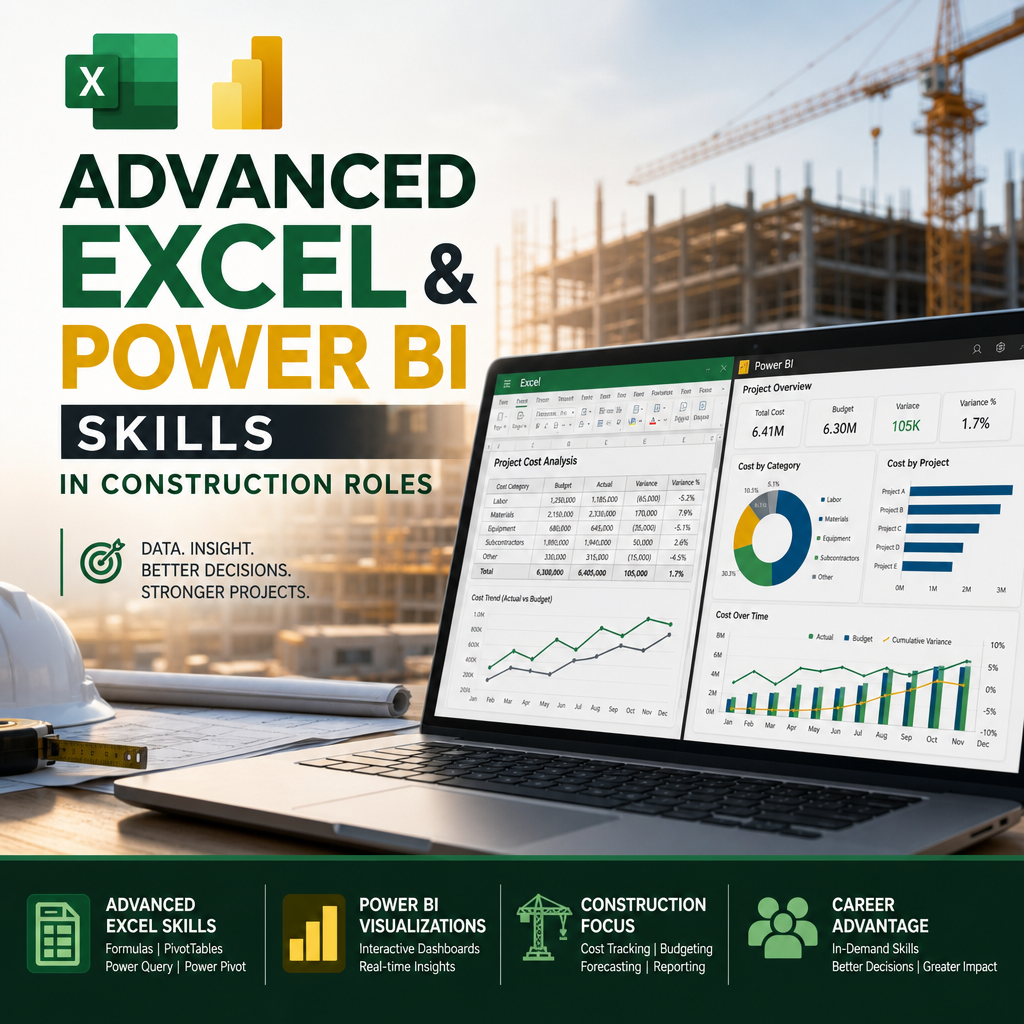
Excel remains one of the most widely used tools in the industry. But advanced Excel goes far beyond simple tables and formulas. It allows construction professionals to create powerful models, automate calculations, and analyze large datasets with precision.
Key Excel skills that add value include:
- Pivot tables for summarizing project data quickly
- Advanced formulas for complex calculations and forecasting
- Conditional formatting to highlight risks or delays
- Data validation to reduce input errors
- Macros and automation to save time on repetitive tasks
- Dashboards to present key metrics clearly
For example, an estimator can use advanced formulas to compare material quantities across designs, while a project controller can build a dashboard to track cost performance in real time. These tools help teams make faster and more informed decisions.
How Power BI Improves Decision-Making
While Excel is excellent for calculations and flexible analysis, Power BI takes reporting and visualization to another level. It helps users combine data from multiple sources and present it in interactive dashboards that are easy to understand.

In construction, this is especially useful because project data often comes from different systems. Costs may be stored in one platform, schedules in another, and site progress in a separate report. Power BI brings all of this together in one place.
Benefits of Power BI in construction include:
- Real-time reporting across multiple projects
- Interactive dashboards for management reviews
- Better visibility of trends, risks, and performance
- Faster access to key project indicators
- Improved communication between office and site teams
Instead of static reports that become outdated quickly, decision-makers can view live data and drill down into specific details. This leads to faster responses and better project control.
Real-World Impact on Construction Roles
Advanced Excel & Power BI skills are valuable across many construction functions. They support both day-to-day operations and long-term strategic planning.
Project managers
Project managers can track progress, compare planned versus actual outcomes, and identify delays early. This helps them stay ahead of issues and keep stakeholders informed.
Quantity surveyors and commercial teams
Commercial professionals can use Excel and Power BI to monitor budgets, manage variations, and control costs more effectively. They can also improve forecasting accuracy and reduce financial risk.
Planners and schedulers
Planning teams can analyze program performance, visualize critical path issues, and present schedule updates in a clearer format. This supports better coordination across teams.
Site managers
Site teams can use simple dashboards to monitor labour, productivity, safety, and materials. This makes reporting more efficient and helps them focus on delivery.
Better Skills Lead to Better Projects
Construction companies that invest in data skills often gain a competitive edge. They can produce more accurate reports, improve internal communication, and respond to problems faster. In an industry where margins are tight and deadlines matter, these advantages are significant.
Professionals with strong analytical skills are also more valuable to employers. They can contribute to smarter planning, stronger controls, and better business outcomes. As digital transformation continues across the sector, demand for these skills will only grow.
Building the Right Capability
The good news is that these skills can be learned. Many construction professionals already use Excel in some form, so moving to advanced tools is a natural next step. Power BI also has a relatively accessible learning curve for those who are comfortable working with data.
A practical development path might include:
- Strengthening Excel fundamentals
- Learning advanced formulas and pivot tables
- Practicing dashboard creation
- Exploring data connections and automation
- Moving into Power BI for reporting and visualization
Even small improvements in these areas can make a big difference in performance and confidence.
Final Thoughts
The construction industry is becoming more data-driven, and professionals who adapt will be best positioned for success. Advanced Excel & Power BI skills help teams manage complexity, improve reporting, and make smarter decisions throughout the project lifecycle.
Whether you work on site, in planning, in commercial roles, or in project leadership, these tools can improve the way you work. In modern construction, digital confidence is not just an advantage. It is a necessity.