
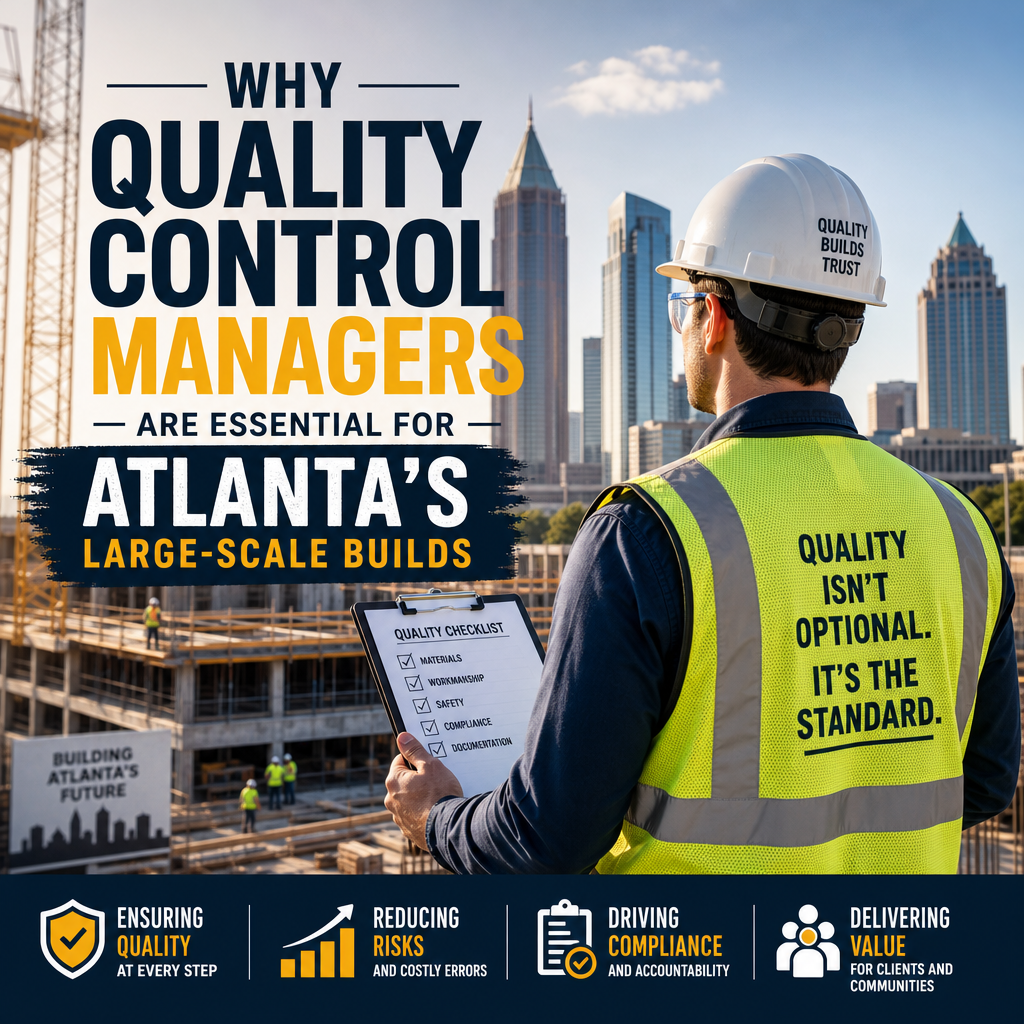
Why Quality Control Managers Are Essential for Atlanta’s Large-Scale Builds
Why Quality Control Managers Are Essential for Atlanta’s Large-Scale Builds
Atlanta’s skyline keeps changing. From commercial towers and mixed-use developments to infrastructure upgrades and industrial projects, the city is built on ambitious timelines and high expectations. In this environment, quality control managers play a critical role in keeping large-scale builds on track, compliant, and built to last.
When projects involve multiple contractors, tight deadlines, and complex regulations, quality can slip fast. That is where a skilled quality control manager makes the difference.
What Quality Control Managers Do
Quality control managers oversee the standards, inspections, and documentation that help ensure construction work meets project requirements. Their job is not just to spot defects. They help prevent them in the first place.

On a large-scale build, that often includes:
- Reviewing plans and specifications
- Inspecting materials and workmanship
- Coordinating with contractors and site supervisors
- Tracking compliance with codes and project standards
- Documenting issues and corrective actions
- Verifying that completed work meets expectations
In short, they serve as the project’s safeguard for consistency and accountability.
Why Large-Scale Builds Need Extra Oversight
Small projects can often be managed with a lean team and a simple inspection process. Large-scale builds are different. They involve more moving parts, more stakeholders, and more opportunities for mistakes.
In Atlanta, that challenge is amplified by rapid growth and a busy construction landscape. With so many projects running at once, teams must balance speed with precision.
A quality control manager helps maintain that balance by ensuring:

- Work is done correctly the first time
- Materials match project specifications
- Defects are caught early, before they become expensive
- Each phase is approved before the next begins
- The project stays aligned with local and industry standards
Without that oversight, even small errors can multiply into major delays and cost overruns.
Protecting Budgets and Timelines
One of the biggest benefits of strong quality control is cost control. Rework is expensive. If concrete is poured incorrectly, if systems are installed out of sequence, or if materials fail inspection, the team may have to tear out finished work and start over.
That means more labor, more materials, and more lost time.
Quality control managers help reduce those risks by catching problems early. Their work can save owners and contractors significant money, especially on large projects where one mistake can affect multiple trades.
They also help protect the schedule. In a fast-moving market like Atlanta, delays can quickly lead to missed deadlines, frustrated stakeholders, and strained budgets. A proactive quality control process keeps projects moving smoothly.
Supporting Safety and Compliance
Construction quality and construction safety often go hand in hand. Poor workmanship can create hazards for workers, tenants, and future occupants. A loose handrail, faulty installation, or improperly sealed system can create serious problems later.
Quality control managers help identify these issues before they become safety concerns. They also ensure work meets applicable codes, industry standards, and project requirements.
For large-scale builds in Atlanta, this is especially important because projects often must satisfy:
- Local building codes
- Environmental requirements
- Fire and life safety standards
- Accessibility regulations
- Owner-specific performance standards
Staying compliant is not optional. It is a core part of delivering a successful project.
Improving Communication Across Teams
Large builds require coordination between architects, engineers, contractors, subcontractors, suppliers, and owners. That level of collaboration can create confusion if responsibilities are not clearly defined.
Quality control managers help improve communication by serving as a central point of reference for inspection results, documentation, and corrective actions. They keep everyone informed about what has been completed, what still needs attention, and what must be fixed before moving forward.
This reduces misunderstandings and keeps teams aligned around the same goals.
Building Confidence for Owners and Investors
For developers and property owners, a construction project is a major investment. They want more than a finished structure. They want confidence that the building will perform as expected and hold its value over time.
That confidence comes from quality.
When quality control managers are involved, owners gain a clearer picture of project progress and construction standards. They can trust that issues are being tracked and resolved before final handoff. This creates a stronger final product and a better long-term outcome for everyone involved.
Atlanta’s Growth Demands Reliable Execution
As Atlanta continues to expand, the pressure on construction teams will only increase. More development means more competition, more complexity, and less room for error. That is why quality control managers are not just helpful on major builds—they are essential.
They help teams:
- Maintain consistency across every phase of construction
- Catch defects before they become costly problems
- Keep projects compliant and inspection-ready
- Support safer, more durable buildings
- Deliver results that meet owner expectations
The Bottom Line
Large-scale construction in Atlanta demands precision. Deadlines are tight, project scopes are complex, and the cost of mistakes is high. Quality control managers provide the structure and oversight needed to keep those projects moving in the right direction.
They protect budgets, improve safety, reduce rework, and help ensure that major builds stand the test of time. In a city defined by growth and transformation, that makes them one of the most important roles on the job site.