
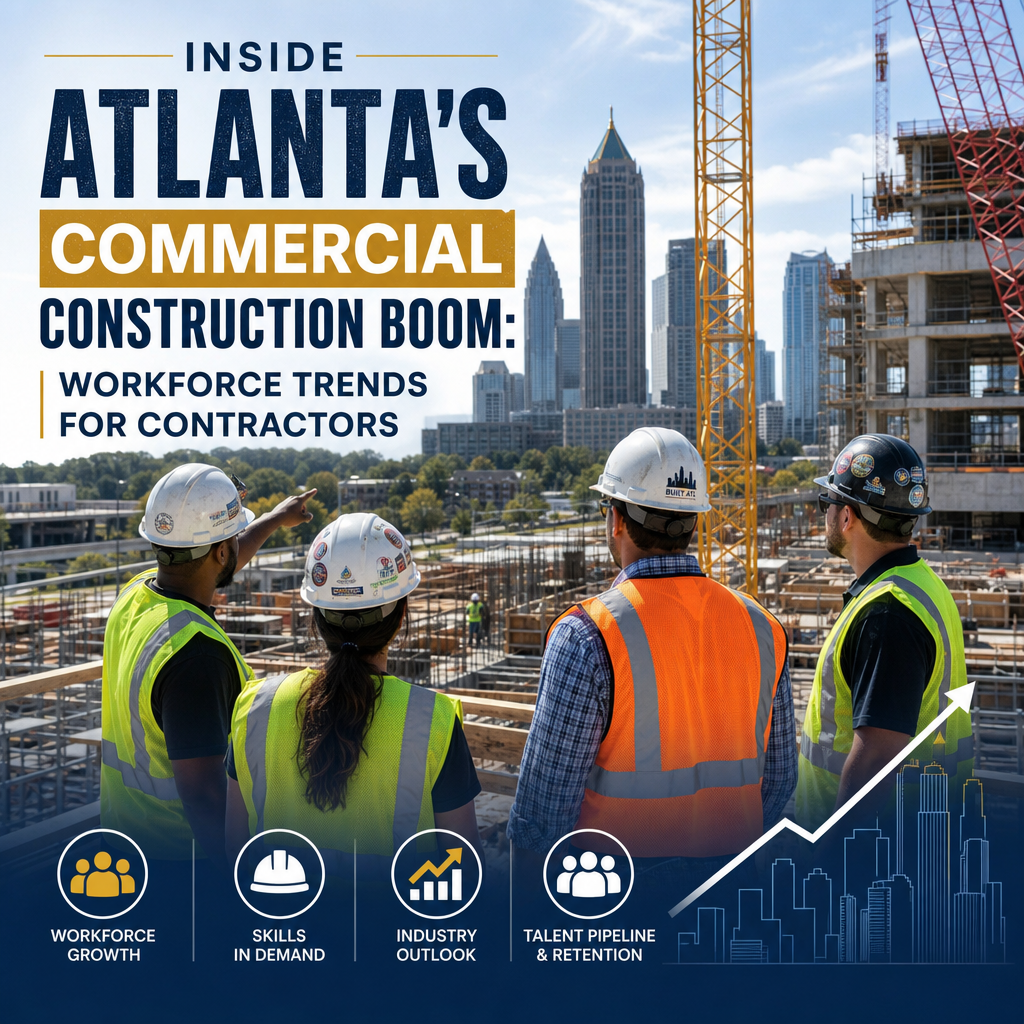
Inside Atlanta’s Commercial Construction Boom: Workforce Trends for Contractors
Inside Atlanta’s Commercial Construction Boom: Workforce Trends Every Contractor Should Know
Atlanta’s skyline keeps changing, and so does the demand behind it. From logistics hubs and mixed-use towers to office renovations and healthcare expansions, the city’s commercial pipeline remains active. For contractors, that growth brings opportunity — but it also brings a tougher labor market, tighter schedules, and higher expectations from owners and developers.
Understanding the current workforce landscape is no longer optional. In a fast-moving market like this, contractors who track hiring trends, retention challenges, and skill gaps are better positioned to bid accurately and deliver projects on time.
Why Atlanta’s construction market keeps heating up
Atlanta continues to attract corporate relocations, population growth, and infrastructure investment. Those pressures create steady demand for commercial builds across multiple sectors.

Some of the biggest drivers include:
- Major logistics and distribution projects
- Office-to-use conversions and interior renovations
- Healthcare and life sciences expansion
- Hospitality and multifamily development
- Transit, road, and utility improvements
This broad mix of work is one reason the city has become such an active commercial construction market. But more demand also means more competition for workers.
The labor shortage is still the biggest challenge
One of the clearest workforce trends in Atlanta’s commercial construction boom is the ongoing shortage of skilled labor. Contractors across the region continue to report difficulty finding qualified workers for both field and supervisory roles.
The shortage is especially noticeable in trades like:
- Electrical
- Plumbing
- HVAC
- Concrete
- Carpentry
- Welding and steel erection
Even when job pipelines are full, staffing the work can still be difficult. That often leads to schedule delays, higher overtime costs, and pressure to do more with fewer people.

For contractors, this means workforce planning has to happen earlier. Waiting until a project is awarded to line up labor can be risky in today’s market.
Retention matters as much as recruitment
Hiring is only half the battle. Keeping workers is just as important, especially in a market where skilled labor is constantly being courted by competing firms.
Retention problems often stem from:
- Inconsistent project planning
- Unclear advancement paths
- Limited training opportunities
- Better pay offers from competitors
- Burnout from overtime-heavy schedules
Contractors who build loyalty through predictable work, strong communication, and real career development are more likely to keep their best people. In a competitive market, small improvements in workplace culture can make a big difference.
Younger workers expect a different construction career
Another important trend is the changing profile of the workforce. As older tradespeople retire, Atlanta contractors are trying to attract younger workers who often have different expectations about the job.
Younger candidates tend to look for:
- Clear training and certification pathways
- Tech-friendly jobsite tools
- Safer, better-organized job environments
- Opportunities for advancement
- Companies with visible values and stability
This shift is forcing contractors to rethink how they recruit. Traditional hiring methods alone may not be enough. Schools, apprenticeships, workforce boards, and digital recruiting platforms are becoming more important for filling the pipeline.
Technology is changing jobsite expectations
Atlanta’s commercial projects are also pushing contractors to adopt more technology, and that affects labor requirements.
Tools like building information modeling, cloud-based project management, drones, and digital safety tracking are becoming more common. While technology can improve efficiency, it also changes what employers need from their teams.
Workers now need to be comfortable with:
- Mobile devices and apps
- Digital time tracking
- Project collaboration platforms
- Safety reporting systems
- Updated equipment and controls
This creates both a challenge and an opportunity. Contractors who train workers well can improve productivity and reduce mistakes. Those who ignore the shift may struggle to keep up with project demands.
Supervisors are in especially high demand
It is not just field labor that is hard to find. Experienced foremen, superintendents, and project managers are increasingly valuable across Atlanta’s commercial sector.
These roles require more than technical knowledge. They also demand:
- Scheduling ability
- Conflict resolution
- Communication skills
- Safety leadership
- Coordination across trades
With multiple projects moving at once, strong supervisors can be the difference between a profitable job and a costly one. Many contractors are focusing more attention on leadership development so they can promote from within rather than compete for outside talent.
Safety and quality are tied to workforce stability
When staffing is tight, safety and quality can slip if teams are stretched too thin. That’s a major concern on fast-paced commercial sites where deadlines are aggressive and coordination is complex.
A stable workforce supports:
- Fewer accidents
- Better workmanship
- More consistent productivity
- Lower rework costs
- Stronger client relationships
For contractors, protecting safety and quality is also a workforce strategy. People are more likely to stay with companies that value both.
What contractors should do now
To stay competitive in Atlanta’s commercial construction boom, contractors should take a more strategic approach to workforce planning.
A few practical steps include:
-
Build talent pipelines early
Partner with trade schools, apprenticeships, and local training programs. -
Invest in retention
Offer clear growth paths, reliable schedules, and competitive compensation. -
Train for both craft and technology
Combine hands-on skills with digital tools and jobsite systems. -
Develop internal leaders
Promote strong workers into supervisory roles with support and mentoring. -
Align staffing with project volume
Forecast labor needs before bidding and keep subcontractor relationships active.
The bottom line
Atlanta’s commercial construction boom is creating real momentum, but it is also exposing workforce weaknesses across the industry. Contractors who understand labor shortages, retention challenges, technology shifts, and leadership gaps will be better prepared to deliver successful projects.
In a market moving this quickly, workforce strategy is a competitive advantage. Those who plan ahead will be the ones best positioned to grow with the city.